
Your Posts Are Boring. Here's How To Fix them
The playbook I wish someone had given me earlier
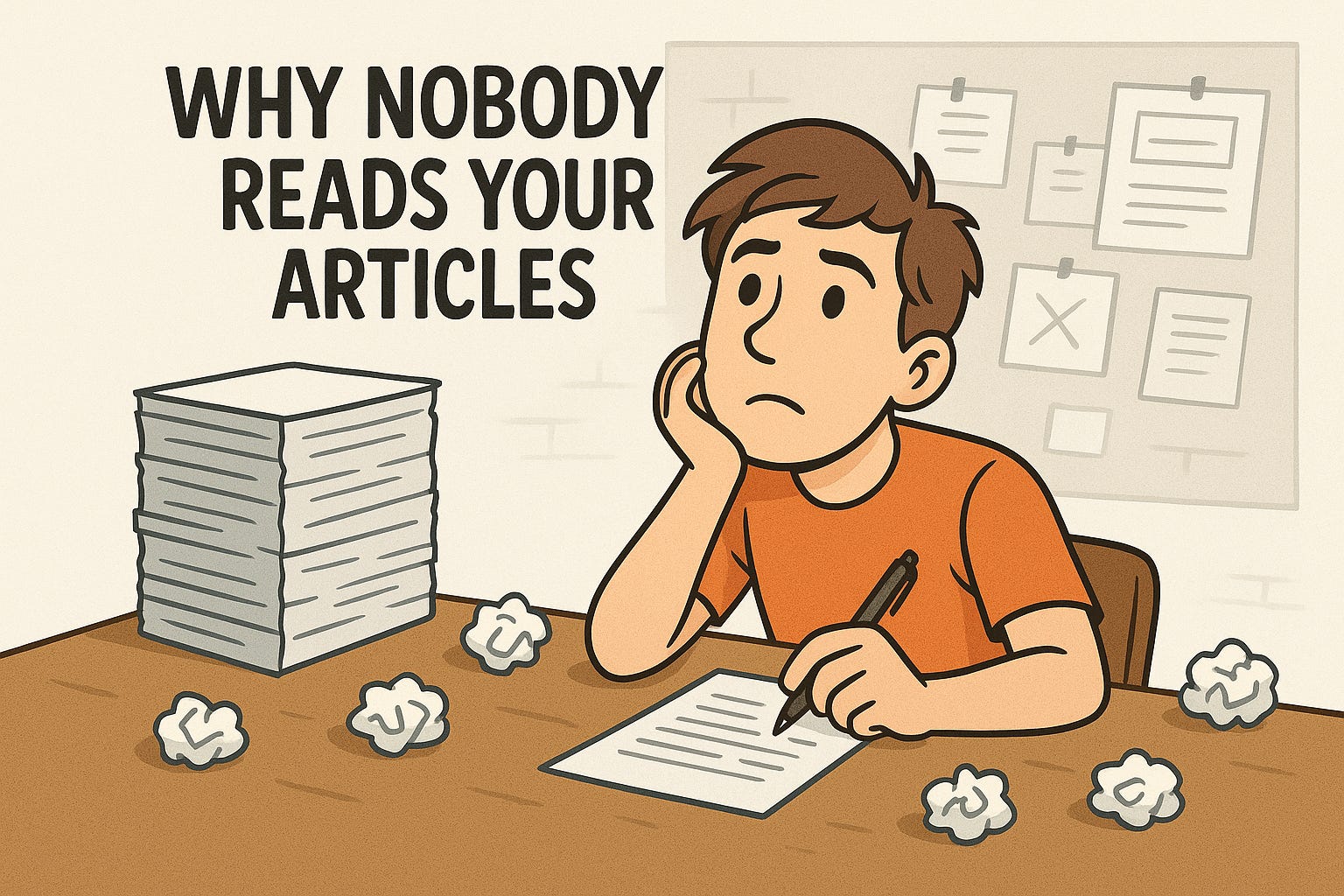
Listen. I'm about to save you from the same mistakes I see a bunch of writers make time and time again.
Here’s the first one: thinking readers care deeply about your writing.
Most new writers’ problem isn’t that they don’t have anything interesting to say. They just don’t realize how little people care.
And if it’s not structured to grab attention, nobody’s going to read it.
They just don’t realize how little people care, and if it’s not built in the correct way, nobody’s going to read it.
Scratch that. Nobody reads your entire article. They skim it.
They read the title first, then look through subheadings and images to decide if it’s worth their time.
And this article isn't another fluff piece abou
t "finding your voice."
This is an easy-to-follow playbook I wish someone had given me before I started writing.
Many writers get this backwards
Before we dive into the article, let's address the elephant in the room: AI.
I see writers every day treating ChatGPT like their personal ghostwriter and just copy and pasting its response.
AI is a genius in helping you get started. But it shouldn’t write your article.
Use it to brainstorm angles, build an outline, generate 15 different hooks or even coach you on your writing (
fantastic idea).But the moment you let it write everything for you, you lose.
Your readers can smell AI-written content from a mile away. It's like serving microwaved food at a five-star restaurant.
(I bet your AI-senses tingled for this last sentence)
The Title
I chose to start with the title because it might be the most important aspect of your entire article.
You can write the best article anybody has ever read.
But if you don’t make those people click your email to see what’s inside and read your work, it’s worthless.
So your title has one job:
GET EYEBALLS ON THE ARTICLE.
It doesn’t matter if it’s clickbaity or not. You are one email among dozens, if not hundreds, of emails.
I know that clickbait is a “foul” word.
But how are you supposed to get people interested enough to click your article when you're a small creator?
Now, I am not talking about straight-up lying.
But exaggerating and making it sound way more than it actually is, using specific words, is 100% legit.
Here are 3 ways to make your title more “clickbaity”:
1. Use Greed and Urgency Words
Words like: free, secret, final, explode, never again, jackpot, save, rich, discount, deadline.
These words trigger curiosity and primal instincts. People click emotionally, not logically.
Example:
❌ “How to Save Money on Groceries”
✅ “5 Dirty Tricks Rich People Use to Slash Grocery Bills — And You Can Too”
2. Frame with “You vs. Them” Conflict
Create tension. Make it a story of you vs. the world, you vs. your past self, or you vs. everyone who doubted you.
Example:
❌ “How I Built My Newsletter”
✅ “They Laughed When I Said I’d Make Money Writing Online — Now They’re Begging Me to Teach Them”
3. Pack It With Specifics and Surprises
Numbers work. Odd ones work even better. Add a twist to make it unpredictable.
Example:
❌ “How to Grow on Substack”
✅ “I Hit $500 MRR on Substack In 2 Months and No Audience. Here’s What Actually Worked.”
Pro tip:
Even if you exaggerate too much, that’s fine. Acknowledge it at the beginning of the article with something like:
“Yeah, I almost puked from the title as well. But I promise it’s worth it.”
Just make sure to follow through on the promise and not lie outright.
The Hook
If your title brought them in, your hook decides if they stay.
Most writers screw this up big time. They open with generic statements like, "In today's world, content is king," or "Everyone wants to succeed online."
No shit Sherlock.
You’ve got exactly three seconds to keep your reader's attention (even less). And the way to do it is by giving them something vivid, personal, and provocative.
Use This Hook Formula:
Start mid-action or with an unexpected twist.
Drop a curious or controversial statement.
Ask a question that makes them wonder.
Example:
❌ "Growing a newsletter takes consistency."
✅ "I woke up sweating at 2 AM, panicking over a typo in my latest viral newsletter."
See? You’ve just transformed a generic sentence into an interesting story.
Subheadings Are Your Secret Weapon
Remember how I said nobody actually reads your article? They skim. Your subheadings need to tell a compelling story all by themselves.
You want your reader to get the whole picture just from scanning.
If they're intrigued enough by those bold lines, they'll dive into the actual content and maybe even read it throughout.
How to Write Magnetic Subheadings:
Each subheading should deliver one clear promise.
Use numbers, strong verbs, or emotionally charged words.
Tease the content without giving everything away.
Example:
❌ "Use AI to Improve Your Writing"
✅ "The One AI Trick That Doubled My Engagement (Without Sounding Robotic)"
Inject Personality and Opinion
There’s no shortage of generic, lifeless content online. It’s crazy.
Your readers aren’t there for that generic fluff. They want to read YOUR unique perspective and spin.
Don’t be afraid to take a strong and controversial stance (I know, it’s hard).
A good rule of thumb: if you’re not at least slightly nervous about hitting publish, you're playing it too safe.
Example:
❌ "AI has potential to help writers."
✅ "Most writers are using AI completely wrong—and it’s destroying their credibility."
The Art of Keeping Readers Hooked
Here’s a secret no one talks about enough: storytelling. Humans are hardwired for stories.
Instead of blandly listing facts or tips, wrap them in a narrative.
Storytelling Framework:
Present a relatable problem.
Build tension and stakes.
Offer your unique resolution.
Example:
❌ "I tried writing daily and it was helpful."
✅ "I promised to publish daily for 100 days. By day 20, I almost quit—but then discovered one strategy that changed everything.”
Pro tip:
Start each section with a story. People love those.
Close With a Clear, Strong CTA
If someone reaches the end of your article, you’ve got a fan. Or at least someone who's intrigued enough to stick around.
Don’t leave them hanging.
Give them a clear next step: subscribe, share, comment, or follow. Heck, if you have an offer that you’re trying to sell, like a course or mastermind, that would be the prefect time.
Effective CTA Examples:
"Ready to finally write posts people can’t ignore? Subscribe here."
"Liked this brutally honest advice? Share it with someone who needs a wake-up call."
Don’t Write For Everyone
You're not writing for the entire internet.
You're writing for your ideal reader. Your language, tone, and examples should reflect that.
By trying to please everyone, you end up being boring.
Example:
❌ "It’s important to respect all writing styles."
✅ "Most online writing is trash. Here's how you avoid joining the herd."
Bringing It All Together: The Brutal Truth
Writing articles people actually read isn't rocket science. But it’s not effortless either.
It takes intentionality:
Headlines that hook.
Subheadings that compel.
Personality and authenticity.
Strategic storytelling.
Images with purpose.
Clear calls to action.
Listen, right now, I am about to finish reading this article and I am nervous.
Nervous that maybe I am not the right person to write this.
Nervous that maybe this article will be awful.
Nervous that maybe people would hate it.
But then I think of my motto and relax:
“If your article flops, no one remembers.
But if it succeeds, you gain fans.Win win (win)”
P.S.
The fastest way to grow on Substack is a combination of weekly posts (1-2) and publishing notes daily.
The sweet spot for notes is 2-3 per day.
And as a busy solopreneur, I struggled with it a lot. So I built a tool to help me create, manage and schedule those Notes.
It’s called WriteStack. And you can try it, for free, today, by clicking the button below:
Try it. You’ll get it.
I'm happy I found you. You are very generous and inspirational. Your posts offer a lot for free....and this makes you one of a kind. Thank you. I'll keep coming back.
So I totally get that. This advice makes sense from the perspective of somebody who's trying to get as many eyeballs on their writing as possible or selling a product. But how does it apply jf I am writing my Substack to heal myself and develop confidence in my own value? Thank you for anytime you take to answer.