

Author note:
Hey everybody. Orel here. 👋
Every now and then I see creators assuming that Substack is not what it used to be, and that it’s not growing anymore, a waste of time, yada yada yada..
So I decided to get Claude to dive into the data and see if that’s really the case.
I wasn’t surprised.
This is one of the very few articles that’s free for everybody. Enjoy.
Every few weeks the same conversation resurfaces in my feed. Someone posts that Substack is saturated and that whoever didn’t start in 2023 already missed the gold rush. The post gets a few hundred likes, a dozen writers quietly lose motivation, and nobody checks a single number.
I got tired of watching people make publishing decisions based on vibes. So I pulled every post and every Note in the WriteStack database, 2.9 million posts and 14.5 million Notes spanning January 2023 through June 2026, and measured the thing directly.
What I found is stranger than either the doomers or the cheerleaders claim. Substack’s two surfaces, long-form Posts and the Notes feed, are moving in opposite directions. On one of them, reader attention is growing faster than the content. On the other, content is growing faster than the attention.
Methodology, so you can judge the claims
Dataset: 2.9M long-form posts and 14.5M Notes from the WriteStack database, January 2023 through June 2026. July 2026 is excluded as a partial month. Notes data starts April 2023, the month Notes launched.
Metrics: everything here is public data (reactions, restacks, comments, post counts). No private subscriber or revenue figures were used.
Caveat: this is a large sample of Substack, not the complete firehose. Absolute counts are directional. The argument rests on ratios, medians, and year-over-year comparisons within the same collection method, which hold up regardless of sample size.
Finding 1: Content supply grew roughly 12x on both surfaces
Start with the raw output of the platform. In January 2023, the sample contains about 13,200 posts for the month. In June 2026, it contains 153,000. Notes went from 68,000 in their launch month to 831,000 in June 2026. Both surfaces grew roughly twelvefold in three and a half years, and neither has flattened: post volume grew another 49% in the first half of 2026 versus the same period in 2025, and Notes volume grew 47%.
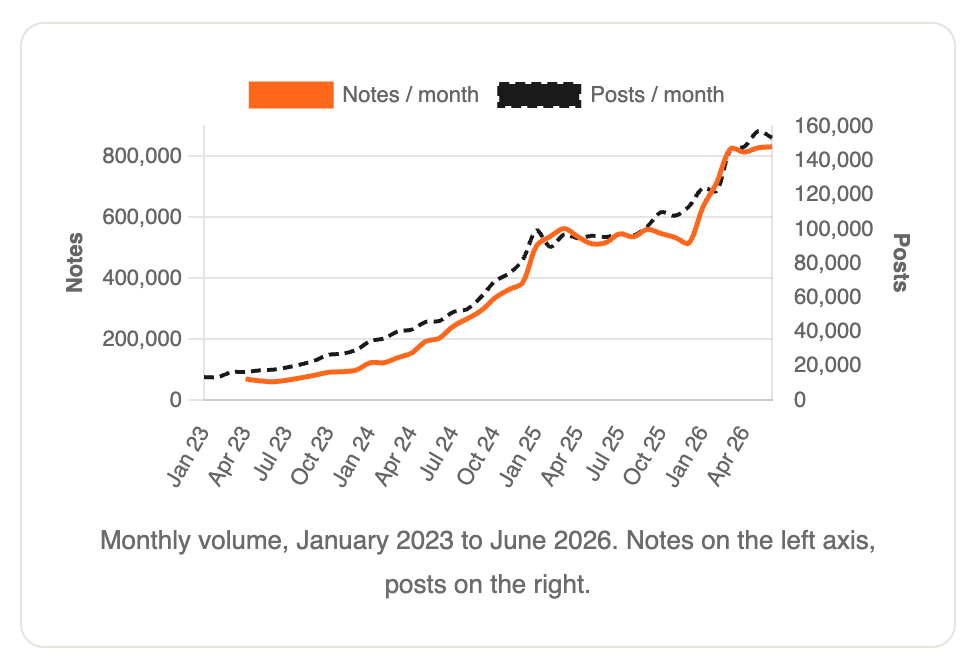
So anyone telling you Substack is shrinking is simply wrong on the supply side. The feed you scroll and the inbox you compete in both carry more content than at any point in the platform’s history.
Mechanism: supply growth alone says nothing about your odds. The question that decides whether Substack is “saturated” is whether reader attention grew faster or slower than the content did. The next three findings answer that, one surface at a time.
Finding 2: Engagement per post tripled anyway
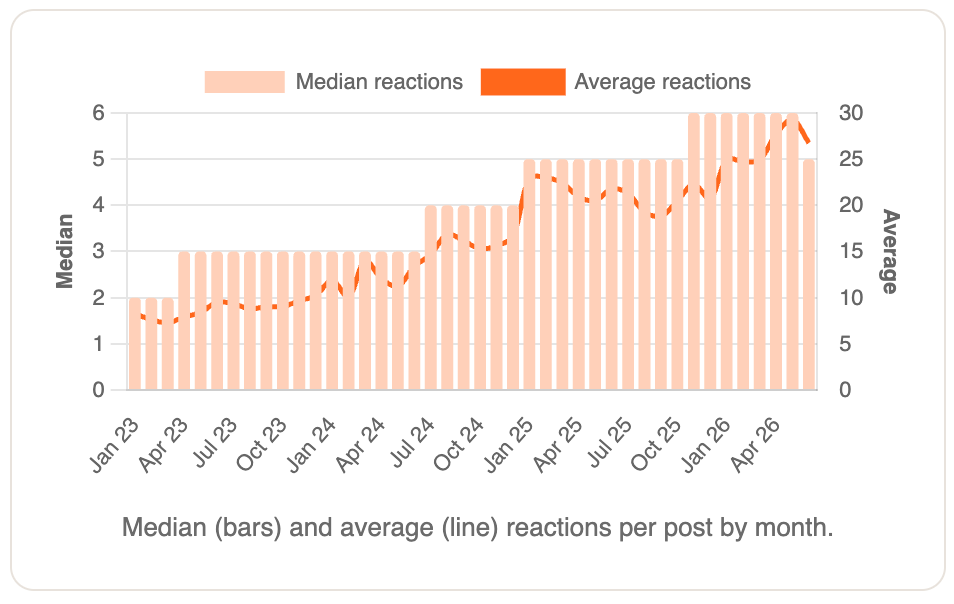
If supply grew 12x, engagement per post should have collapsed. It did the opposite. The median post earned 2 reactions in early 2023 and earns 6 in 2026. The average went from 8.3 to 26.8. Comments per post rose from 2.8 to 5.0.
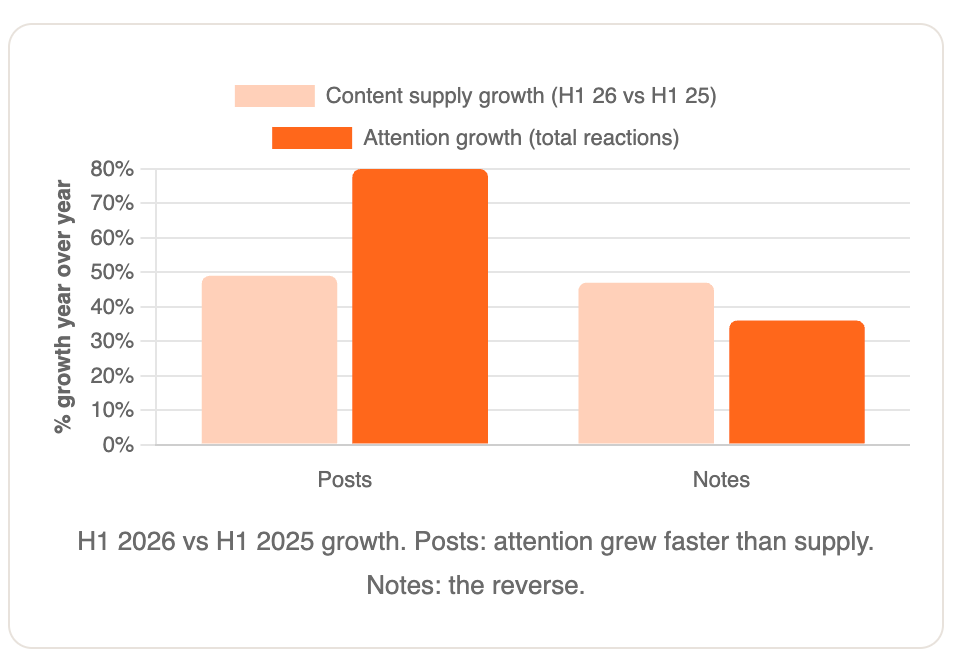
The half-year comparison makes it sharper. In H1 2026, total post reactions grew 80% year over year while post volume grew 49%. On the long-form side, reader attention is growing faster than content supply. Substack is adding readers faster than its writers can feed them.
Mechanism: a reader who subscribes to newsletters compounds. They keep receiving and reacting, and their attention stacks across every writer they follow. A feed scroller’s attention is zero-sum per session. Long-form demand grows with the reader base; feed demand grows only with session time.
What to do with this: Long-form is currently the undervalued asset on Substack. Demand is outrunning supply there, which means the expected return on one good post is the highest it has ever been.
Finding 3: The Notes feed crossed into saturation in mid-2025
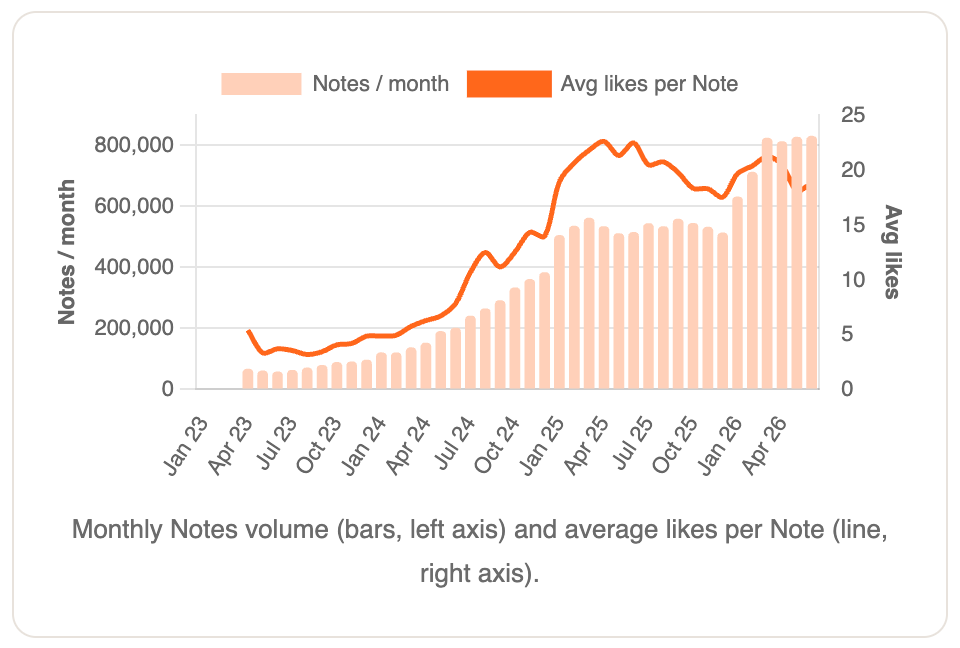
Notes tells the mirror-image story. Supply kept compounding: 831,000 Notes in June 2026, up 61% from the 516,000 of a year earlier, with no sign of flattening.
Attention is not keeping up. Average likes per Note peaked at 22.5 in June 2025 and fell to 18.8 by June 2026, a 16% decline over the same twelve months that volume grew 61%. In half-year terms: Notes volume grew 47% in H1 2026, but total Note likes grew only 36%. On Notes, supply is now outrunning attention. The feed crossed from underpriced to crowded somewhere around mid-2025.
Mechanism: feed attention is bounded by session time, and session time grows much slower than posting volume. When 800,000 notes a month compete for a feed with finite scroll depth, the average note must earn less. This is the same curve Twitter and LinkedIn rode years earlier.
What to do with this: Notes still works, but treat it as what it now is: a top-of-funnel volume game where the average note earns less each quarter. Its job is discovery. The conversion asset is the newsletter it feeds.
Finding 4: On Notes, the jackpot is shrinking and the floor is rising
Inside the declining Notes average hides the most actionable pattern in the dataset. While the average likes per Note fell from 22.5 to 18.8, the median went up, from 2 in 2024 to 3 and then 4 by spring 2026. The average is dragged by outliers; the median is what the typical note earns. They are moving in opposite directions.
The ratio between them measures how concentrated attention is. In June 2025 the average Note earned 7.5x the median. By June 2026, 6.3x. Attention on Notes is spreading more evenly: viral outliers capture a shrinking share while the typical note earns more than ever.
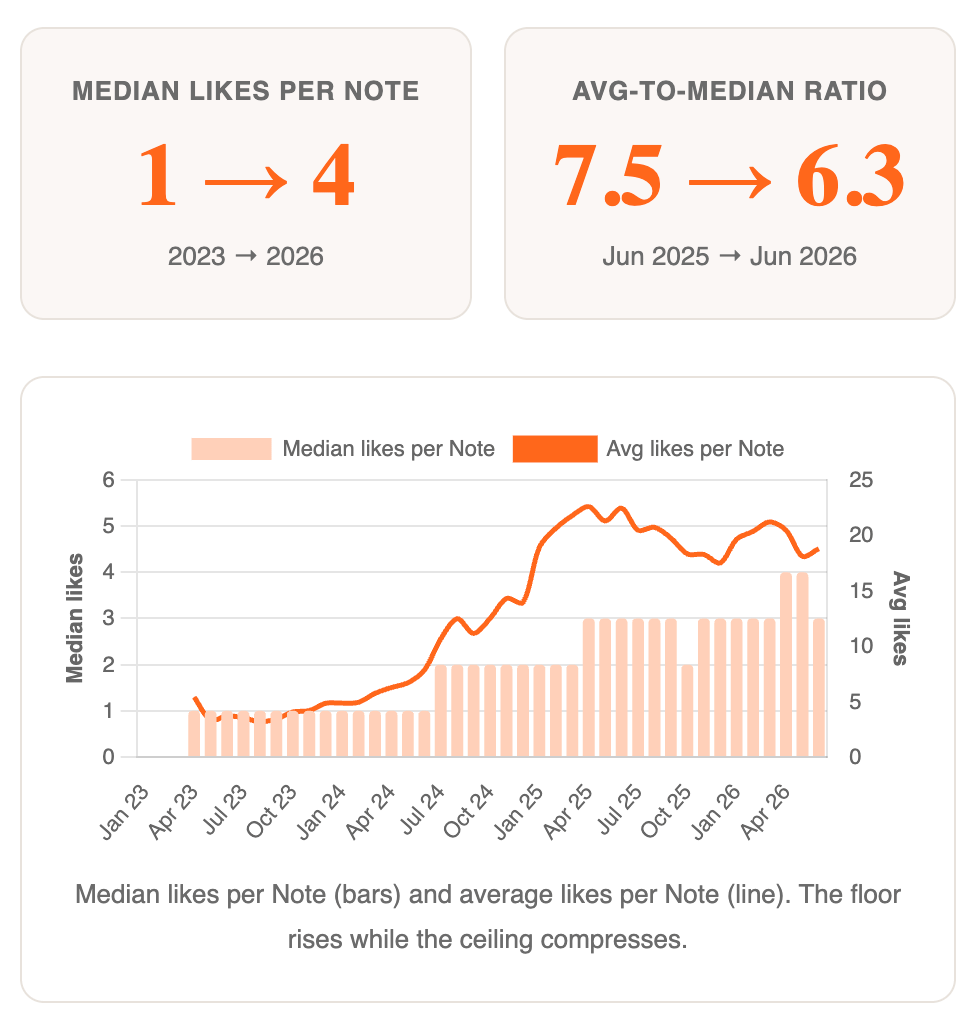
Mechanism: as a feed algorithm matures, it optimizes for session retention rather than discovery shock, which spreads impressions across more creators and dampens runaway virality. The lottery ticket gets worse. The paycheck gets better.
What to do with this: Stop engineering for the viral outlier. The system is paying steady publishers a rising floor rate and taxing jackpot hunters. Twenty decent notes a month now reliably outperform one swing for the fences.
So, is Substack still growing?
Readers, yes, and fast: total reactions grew 80% year over year on posts and 36% on Notes. Content, also yes: both surfaces grew roughly twelvefold since 2023. What decides whether you feel growth or saturation is the exchange rate between the two. On long-form, attention is growing faster than content, so each post earns more every year. On Notes, content is growing faster than attention, so each note earns less.
The honest one-line answer: Substack is still growing, and the returns have moved to long-form. For anyone publishing a newsletter, that is close to the best possible market structure.
The playbook this data implies
Shift weight toward long-form. Post volume grew 49% last year while post reactions grew 80%. Attention is outrunning content there, and every additional post captures part of the surplus.
Use Notes for discovery, not as the destination. Per-note attention is deflating 16% a year. Every note should have a job: pull a reader toward the asset that compounds.
Publish on a fixed cadence. The rising Notes floor and the tripling post engagement reward the writer who shows up every week over the one hunting a single big hit.
Ignore the saturation discourse. Saturation is real on the Notes feed and absent where subscribers actually live. The writers who quit because “it’s too late” are handing you their readers.
P.S. I left a present under this article
The data says the whole surplus goes to writers who ship articles on a cadence. So I wrapped the shortcut. Inside:
A calendar that arrives already full, a month of article ideas planned ahead
Every idea one click away from a draft
Swap ideas you don’t like, drag articles to days that fit
Come unwrap the Articles Planner inside WriteStack. The data already told you to open it.
Excellent and useful analysis Orel. Thank you for putting in the time to put this together.
My personal experience says that both Notes and Posts have become more competitive, and that it has become somewhat harder to reach and maintain visibility with those who do appreciate your work. But I may be measuring a transition point, not a new standard.
I think small creators sometimes have an advantage we don’t appreciate enough.
When only a few people are listening, you can actually talk to them.
Maybe the early stage isn’t something to escape as quickly as possible.