

You write a post you are proud of, and you want people to read it. So you write a note about it, paste the URL at the bottom, and hit publish.
Four hours later the note has two likes and nobody has replied. The note you wrote the day before, the one about nothing in particular, has forty.
Every writer on Substack has run this experiment by accident. Most of us walked away with a vague superstition: links get punished. What almost nobody has is the number. How much reach does a URL actually cost, and does the thing you paid for (a reader who subscribes) ever show up on the other side?
I went looking for both halves of that trade, because the answer turned out to point in two directions at once. And I asked two questions:
What does a link cost you in reach?
What does it buy you in subscribers?
Not here for the nitty gritty? Skip straight to the actionable part at the bottom. Everything worth doing about links is in one block down there.
Finding 1: A link cuts your median likes in half and doubles your chance of getting zero
Notes without a link had a median of 4 likes, and notes with a link had a median of 2. The average fell from 19.4 to 10.7, a drop of 44% across 655,056 notes. That is the headline, and it is not subtl

Average likes by what is in the note
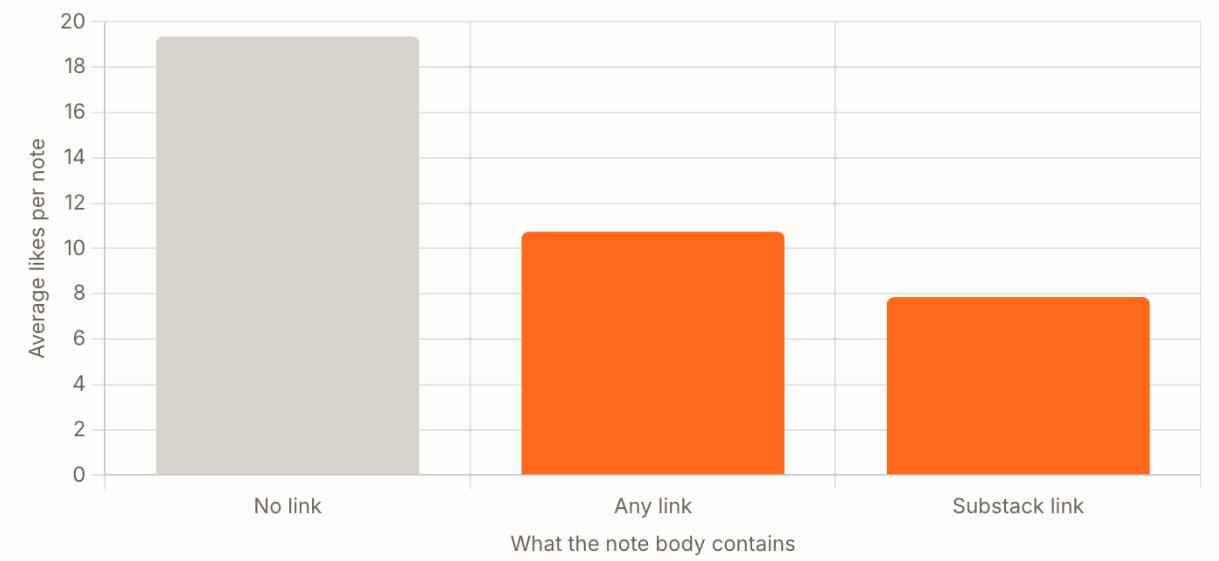
The zero-like number is the one that should worry you. Nearly three in ten link-carrying notes finished July with no likes at all, against fewer than one and a half in ten for notes without a URL. A note with no likes is a note that never entered anyone’s feed beyond the people already following you.
Replies collapse harder than likes. Average replies fell 54%, from 1.53 to 0.70. And when the link points at substack.com specifically, replies fall to 0.49 and restacks fall from 2.11 to 1.29, a 39% drop in the single behaviour that puts your note in front of strangers.
Mechanism
A note with a link asks the reader to leave. A note without one asks the reader to stay. Everything the feed rewards (dwell time, likes, replies, restacks) happens on the surface of the note, and a URL is an exit sign painted on that surface. The reader who clicks is gone before they can like, and the reader who does not click has already been told the note is an advertisement.
Restacks fall hardest for substack.com links because restacking someone else’s promotional note is the least flattering thing you can do with your own feed.
The rule
Budget for it. If you publish four notes a week and one carries a link, you have spent roughly half of that note’s reach before you wrote a word. That is fine when the link is the point. It is expensive when the link was an afterthought.
Finding 2: Length does not explain the penalty
The obvious objection to Finding 1 is that link notes are simply longer. They average 435 characters against 286 for link-free notes, and long notes have their own reach problems. So I ran the comparison inside fixed length bands, where both groups are writing at the same size.
The penalty survives in every band, and standardising for length makes it slightly worse, not better. Unadjusted, link notes get 54.4% of the likes that link-free notes get. Reweighting link notes to match the length distribution of link-free notes moves that to 48.9%.
Average likes at the same note length, with and without a link
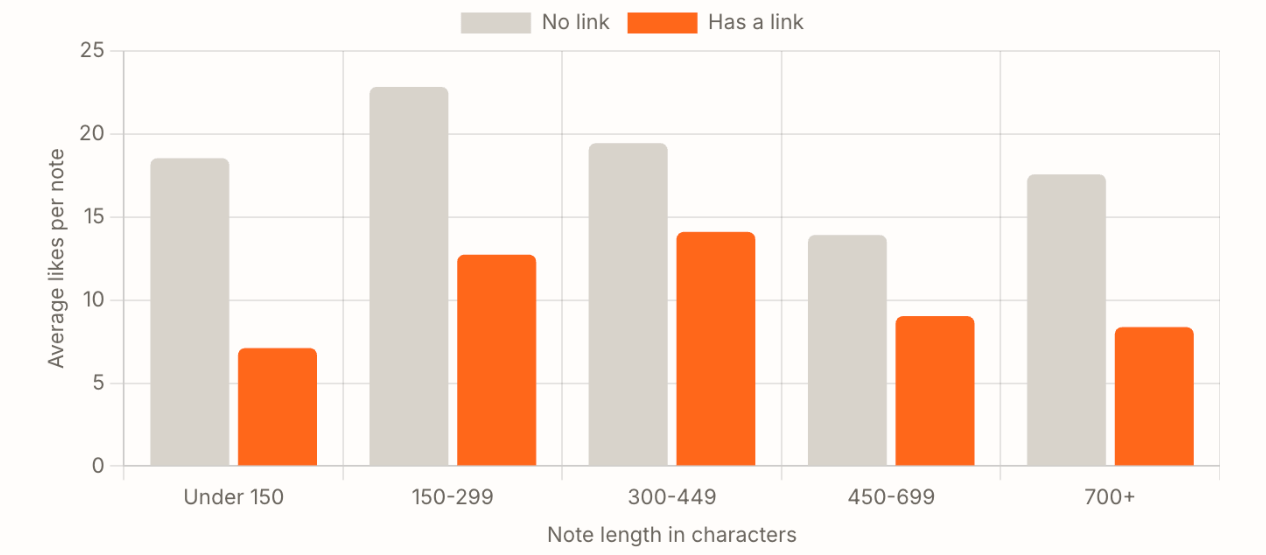
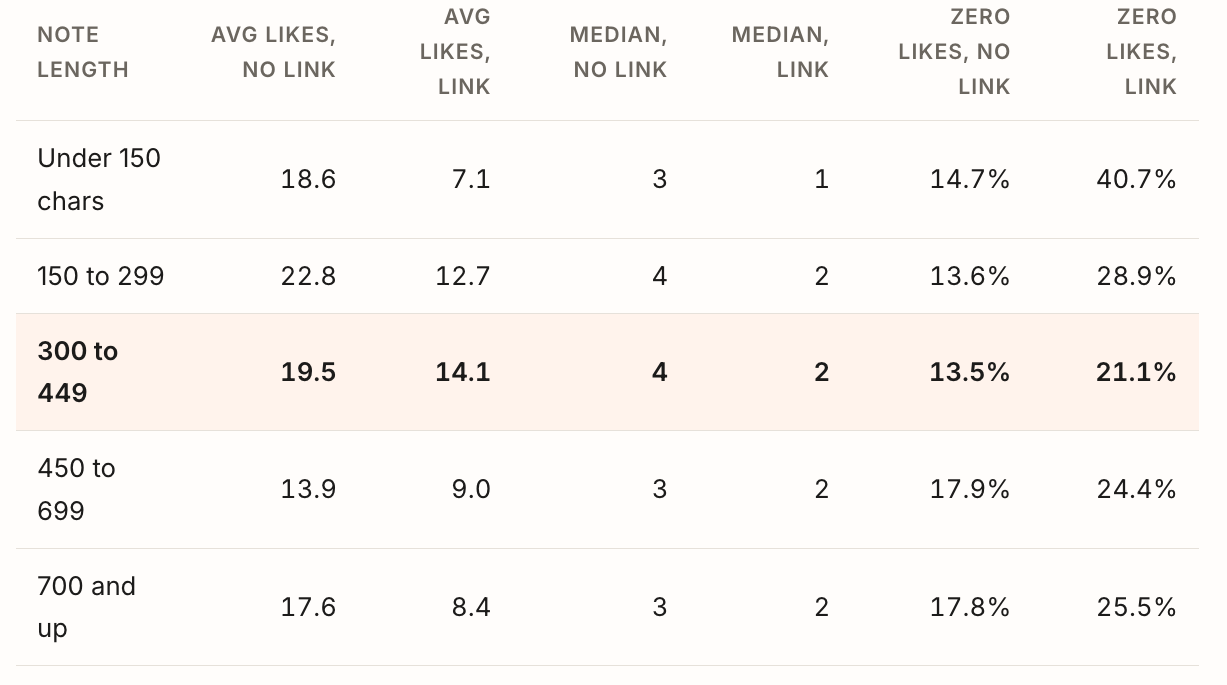
The median is 2 for link notes in four of the five bands and 1 in the shortest one. The link-free median never drops below 3 and sits at 4 in the middle of the range. I ran the same test on the separate 29,993-note conversion sample, which is not stratified at all, and got the same direction: unadjusted ratio 0.35, length-standardised 0.31.
The one thing length does explain is where the damage is worst. A short note with a link is the worst combination in the dataset, with 40.7% of them finishing with zero likes. A bare URL under 150 characters reads as a drive-by.
Caveat
This is a correlational cut, not an experiment. Nobody randomised who put a link in which note. It is entirely possible that the kind of note a writer chooses to attach a link to (the announcement, the round-up) is also the kind of note that would have underperformed anyway. What the length control rules out is the specific alternative explanation that the penalty is really a length penalty in disguise. It is not.
Finding 3: Opening with the link costs more than the link itself
Where the URL sits inside the note turns out to matter more than whether it is there. I measured how many characters of text come before the first URL, across every link-carrying note in the sample.
Notes that open with the link averaged 3.1 likes. Notes with 120 to 299 characters of setup before the link averaged 14.7. That is a 4.7x gap between two groups that both contain a link.
Average likes by how much you say before the URL
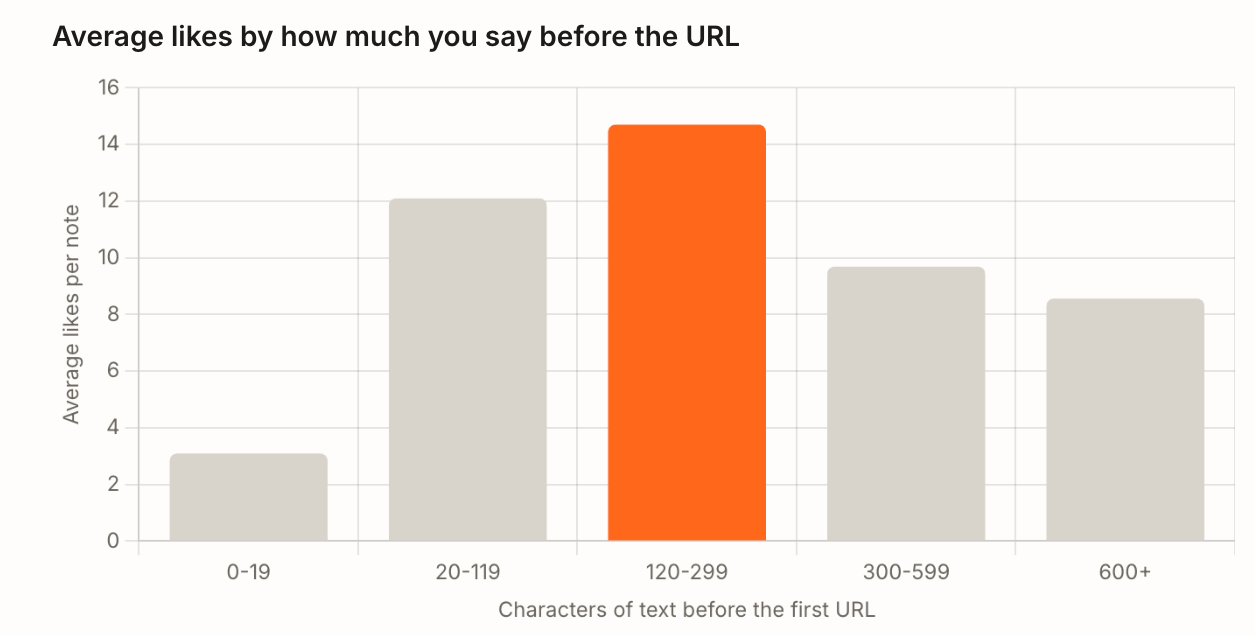
The top decile of link-carrying notes confirms it from the other end. Sorting all link notes by likes, the best 10% open with the URL only 5.0% of the time, against 17.0% for the bottom 90%. They also carry more setup (an average of 339 characters before the first link, against 298) and are less likely to be pointing at substack.com (34.5% against 42.5%).
Here is a clean instance. A full story, told to completion, with the link as a postscript that arrives after the reader already got the whole thing for free.
1,334 likes, 44 replies, 1,095 characters, with the URL as the final line.
Mechanism
A URL in the first line tells the reader what the note is for before the note has earned anything. The reader classifies it as an ad and scrolls. A URL in the last line arrives after the reader has already spent attention, and by then the note has done its job whether or not anyone clicks.
This also explains why the middle band beats the long one. Past roughly 300 characters of setup, the note starts competing with the post it is advertising, and the reader has no reason left to leave.
The template
Give the reader a complete unit of value, then the link, in that order. Target 120 to 300 characters before the URL. Never put the URL on line one.
Finding 4: Every like a Substack link earns is 2.96x more likely to become a subscriber
Now the other direction. Across 29,993 notes from 657 authors with analytics attached, I compared free subscribers gained per note and per like.
Link-free notes converted at 2.22 subscribers per 100 likes. Notes with a Substack link converted at 6.56. That is 2.96 times the efficiency. What the link changes is what happens after the like, by giving the reader who already stopped scrolling somewhere to go.
Free subscribers per 100 likes, by link type
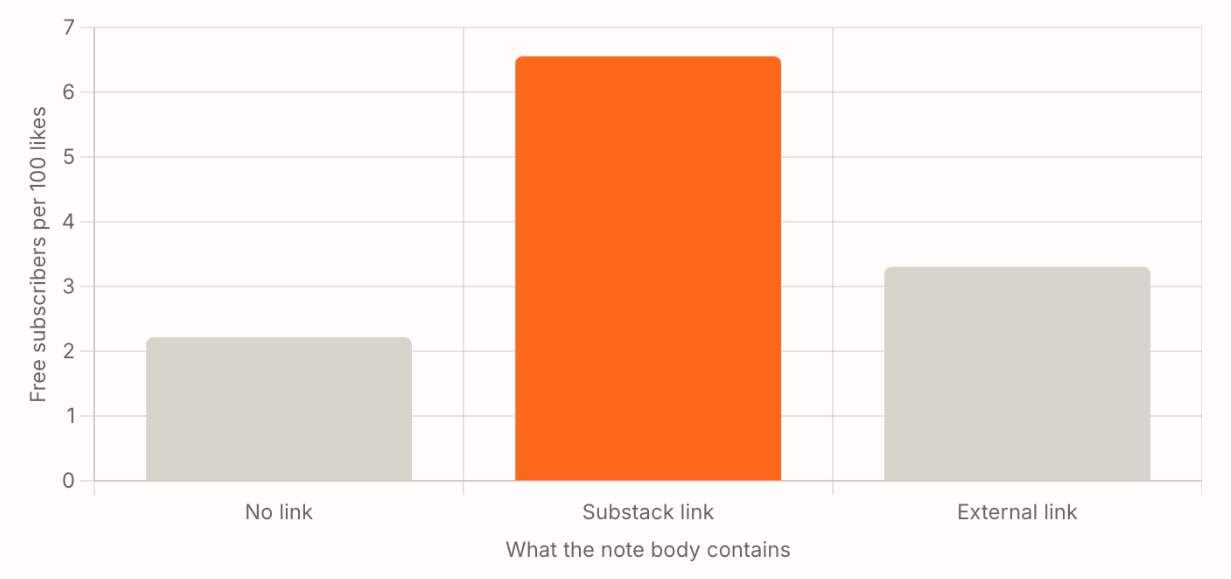
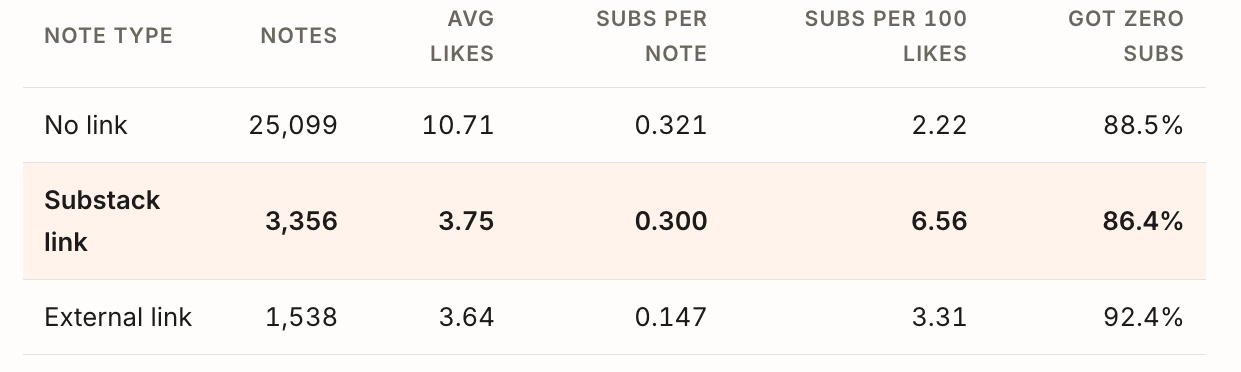
Read the middle column before you get excited. Subscribers per note actually fell, from 0.321 to 0.300, a drop of 7%. The efficiency gain is real, and it is almost exactly cancelled by the reach loss that produced it. A Substack link buys you a much better conversion rate on a much smaller audience, and the two effects land within a rounding error of each other.
The external-link row is what settles the argument. Same reach penalty (3.64 average likes against 3.75), but 0.147 subscribers per note, less than half of what a Substack link returns, and a 92.4% chance of producing no subscribers at all. If you are going to pay the reach tax, the link had better point at your own publication. Sending your feed to a YouTube video or a news article costs you the same audience and returns you half the readers.
Mechanism
A substack.com URL lands the reader on a page with a subscribe button above the fold and a one-click signup, because they are already logged in. An external URL lands them on someone else’s website, where the best case is that they come back later and remember who sent them. The conversion machinery only exists on one side of that door.
Finding 5: The reach cost is near universal. The subscriber gain is a coin flip
Population averages hide author quality. Maybe the writers who post links are simply smaller writers. So I looked inside individual authors, comparing each writer’s own link notes against their own link-free notes, using the 147 authors who published at least five of each in July.
127 of 147 authors, 86.4%, got fewer average likes on their own link notes. The median within-author ratio was 0.58, almost exactly the population figure. So the reach tax survives once author quality is held constant, which means it happens to nearly everyone, including you.
On subscribers, 71 of 147, 48.3%, did worse with links. That is a coin flip.
Share of authors whose own link notes underperformed their own link-free notes
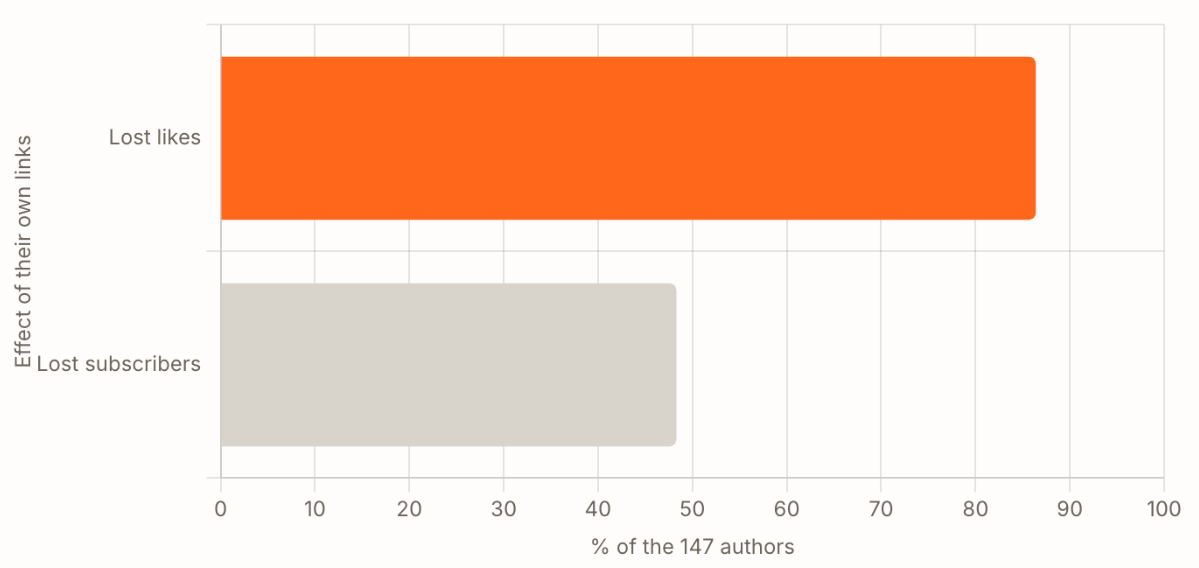
Efficiency splits the same way. Link notes were more efficient per like for 74 of 145 authors, which is 51%. The 2.96x figure from Finding 4 is an arithmetic fact about the whole population, and it is driven by a small number of authors whose linked notes convert extremely well. For the typical writer it is close to even.
How to read this
These two results are consistent, not contradictory. The link reliably costs you reach and unreliably returns you subscribers. Once you accept that framing, the decision stops being “do links work” and becomes “is this specific note worth half its audience.” Sometimes it plainly is.
Finding 6: Naming the post without linking it keeps 3.3x the reach
There is a third option that most writers ignore. You can point at your work without pasting the URL. I flagged every link-free note in the conversion set that referenced the author’s own post, essay, newsletter, or publication in words alone, without a URL anywhere in the body. That is 1,001 notes from 272 authors.
Those notes averaged 12.52 likes against 3.75 for notes carrying a Substack link, a 3.3x difference, and they beat the overall link-free average of 10.71 as well. Median 4 likes, median length 345 characters. Saying “my latest post” costs you nothing. Pasting the URL costs you two thirds of the room.
Average likes: pointing at your work, versus linking to it
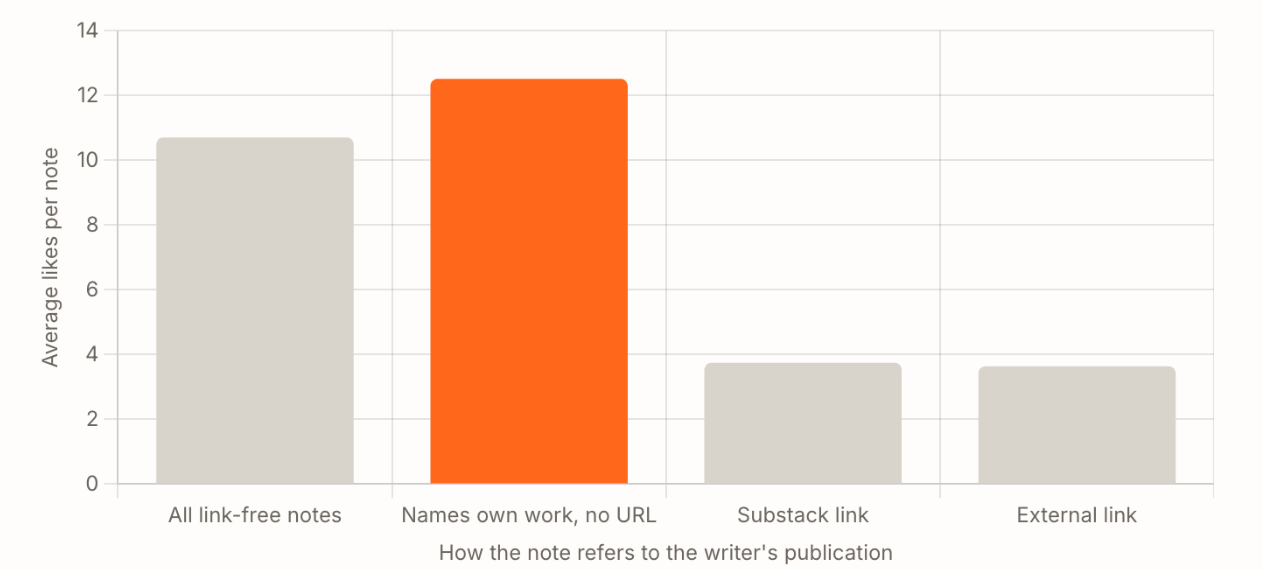
The reach effect holds inside authors too. Among the 40 writers who published at least three of each kind, 34 of 40 got more likes from their unlinked mentions than from their linked notes.
Be careful with the subscriber side of this one. The mention group averaged 0.563 free subscribers per note, above both the link-free baseline and the Substack-link group, but that figure is carried by the tail: five authors account for 47% of the subscribers in the group, and dropping the top three still leaves 0.379. Inside those same 40 paired authors, their linked notes converted better per note than their unlinked mentions (0.509 against 0.316). The mention is a reach instrument, not a replacement for the link.
244 likes, 160 characters, no URL. The publication is named in the last six words.
Mechanism
The feed appears to price the URL, not the intent. A note that says “recipes are on my Substack” is still a promotion, and readers know it, but it contains no exit and nothing to classify as an ad at a glance. The reader who wants the recipes has to go find you, which is a filter, and the readers who do not want them still liked the joke.
The payoff: when to pay the link tax
Here is the whole study compressed into a decision you can make in ten seconds before you hit publish.
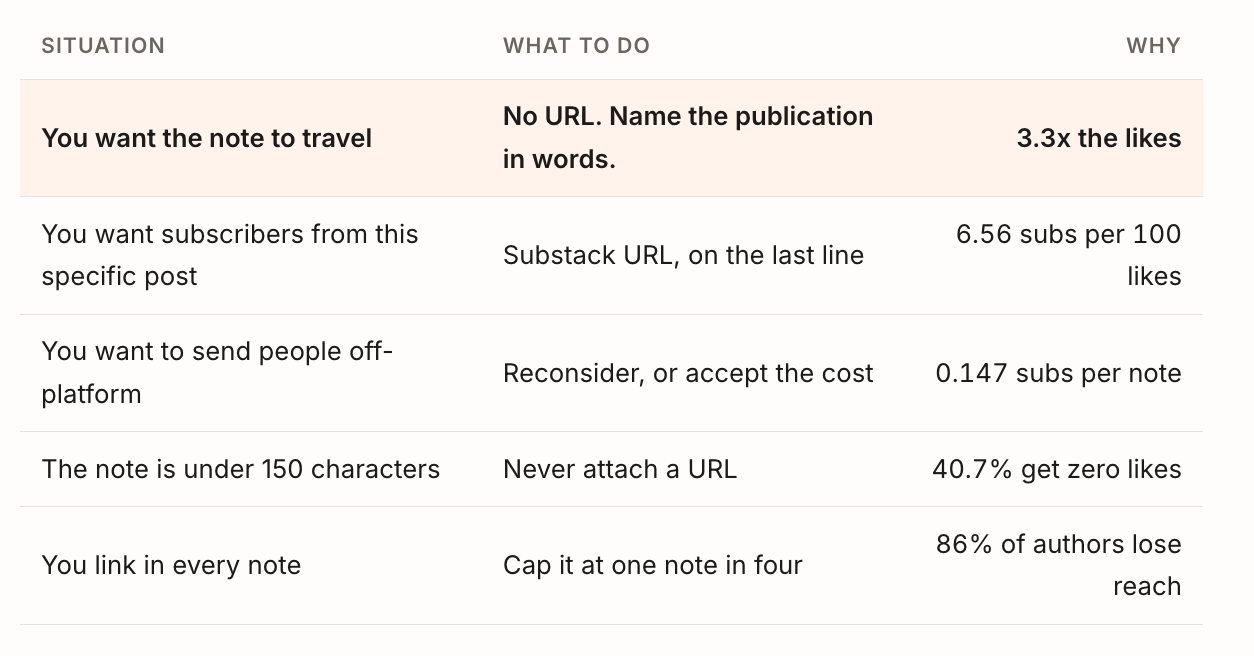
The three numbers to remember
A link halves your median likes (4 to 2) and doubles your zero-like rate (14.6% to 29.0%). Length does not explain it.
A Substack link converts 2.96x better per like (6.56 against 2.22 subscribers per 100 likes) and still ends up 7% behind on subscribers per note, because the audience it converts is so much smaller.
An external link costs the same reach and returns 0.147 subscribers per note, less than half what a Substack link returns. That one is rarely worth it.
The link tax is real, it is roughly 50% of your reach, and it is charged whether or not the link works. Pay it when the click is the entire point of the note. The rest of the week, say the name and let people come find you.
TL;DR
Cut the URL when you want the note to travel. A link drops the median from 4 likes to 2 and doubles the odds of finishing with nothing, 14.6% to 29.0%, and controlling for length makes that worse rather than better.
Name the post in plain words instead of pasting the URL. Notes that referenced the writer’s own work with no URL anywhere averaged 12.52 likes against 3.75 for notes carrying a Substack link, 3.3x the reach.
When you do link, give the reader 120 to 300 characters first and put the URL on the last line. Notes that open with the URL averaged 3.1 likes against 14.7 for notes with 120 to 299 characters of setup ahead of it.
Point the link at your own Substack, not at anyone else’s site. An external link costs the same reach and returns 0.147 free subscribers per note, less than half of the Substack link’s return, with a 92.4% chance of producing no subscribers at all.
Never attach a URL to a note under 150 characters. 40.7% of short link notes finished July with zero likes, the worst combination in the dataset.
Useful info. This explains the limited reach I've seen in notes with links.
Great article with more numbers than a Bingo board (which makes my head spin). Thanks for the TL;DR. What relief 🙂.
As an aside, Orel. Have you analysed engagement comparisons between notes with and without images?